Aurel-George Mohan
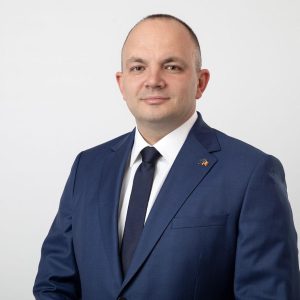
Professor Dr. Mohan Aurel-George, was born in the city of Bucharest on 27.04.1983, and lives in Oradea - Bihor county, graduated from the Oltea Doamna General School in Oradea, after which he graduated from the Mihai Eminescu National College in 2001. He attended the Faculty of Medicine and Pharmacy Oradea, specializing in General Medicine in the period 2002-2008, after which he was a resident doctor in the clinical department of Neurosurgery at the Bihor County Emergency Clinical Hospital between 2009-2015. In 2014, he obtained the title of doctor in medical sciences at the doctoral school of the Carol Davilla University of Medicine and Pharmacy in Bucharest.
He began his university career in 2009, obtaining through a competition the position of university trainer in the Department of Surgical Disciplines, Faculty of Medicine and Pharmacy, University of Oradea. In 2016, he took the exam for the position of Lecturer at the University of Oradea - Faculty of Medicine and Pharmacy, and at the same time, from the position of specialist neurosurgeon, he became the head doctor/coordinator of the operating room at the Bihor County Emergency Clinical Hospital. In 2019, he becomes Associate Professor at the University of Oradea, and in 2021 he takes the primary exam, thus becoming a senior neurosurgeon also at the Oradea Neurosurgery Clinic. In 2022, he takes the exam for the position of Full Professor at Oradea University and is appointed Secretary of State at the Bucharest Ministry of Health, where he begins his work.
Currently, Dr. Mohan Aurel-George leads the residency program at the Oradea Neurosurgery Clinic, as a Professor and senior neurosurgeon and is the coordinator of the Bihor County Emergency Clinical Hospital.
Abstract
Customized polyetheretherketone (PEEK) cranial repair system implants used in cranioplasty after severe traumatic brain injury (TBI).
Mohan G. Aurel1, Ghiurău N. Adrian1, Vlad S. Valentin1, Herciu Alexandru1.
1)Faculty of Medicine and Pharmacy, University of Oradea, Faculty of Medicine and Pharmacy, Department of Surgical Disciplines, Romania,
E-mail: a)mohanaurel@yahoo.com / Tel.: 0040740514636
Cranioplasty represents the surgical procedure to repair a defect of the skull bone. The loss of cranial bone integrity due to a trauma or injury of the head is a contemporary example of tissue failure, which usually requires the permanent or temporary implantation of a bone substituent and may become challenging in case of large defects. Our paper presents a study regarding post-traumatic cranioplasty using polyetheretherketone (PEEK) implants. The aim of this study is to report the using of polyetheretherketone (Peek) implants in cranioplasty with biomaterials after severe traumatic brain injury, for patients with decompressive craniectomies.
The implant allows the replacement of the bone gaps of the patient's craniofacial skeleton. The implant is modeled and sized to fit the individual anatomy of each patient. The implant is designed with a software, after receiving the patient's CT scan and made of polyetheretherketone (Peek), being supplied as a single component or as multiple components. The implant is attached to the native bone with self-locking plates or fixed using standard cranial fixation systems or using standard titanium screws.
We reviewed a number of 17 cases which were subjected to cranial reconstruction following traumatic brain injury. A total of 17 patients, 11 males and 6 females, aged between 19 and 54 years, underwent elective delayed cranioplasty surgery to achieve morphological and functional rehabilitation of the cranial vault performed during the period from 1st January 2020 to 31stDecember 2024. All surgeries were performed in accordance with the widely-accepted indications for cranioplasty and all patients were admitted on the Neurosurgical Department of Bihor County Emergency Hospital. Biomaterials implants are a safe and time effective way to reconstruct cranial defects following severe traumatic brain injury. Among the advantages of polyetheretherketone implants is their‘s nonferromagnetic capacity which permits the safe examination in magnetic resonance imaging high field, useful for long-term follow-up. Prefabricated Peek implants were effective for cranioplasty, reducing surgical time, surgical blood loss and technical simplicity. There were no infected implants and none of the patients required a second surgery.
Biomaterials represent a tremendous leap forward in the surgical management of skull deformities. Biomaterials implants are extremly effective for cranioplasty. These implants also contribute in a special way to the social reintegration of these patients, the psychological component having an essential role in their recovery and helping the patients to return to normal activities.
BioReMed 2025
Date de contact:
Antoniac Iulian
313 Splaiul Independentei Street,
J Building District 6,
Bucharest, Romania, 060032
All rights reserved © copyright by bioremed.ro